





Introduction
Hiring a new employee is only the beginning of the employee experience. What happens between accepting a job offer and completing the first few weeks can significantly influence how comfortable, confident, and productive a new hire becomes. This is where preboarding and onboarding play important roles.
Although these terms are sometimes used interchangeably, they describe different stages of the employee journey. Understanding the difference can help businesses create a smoother and more welcoming experience for new employees.
What Is Preboarding?
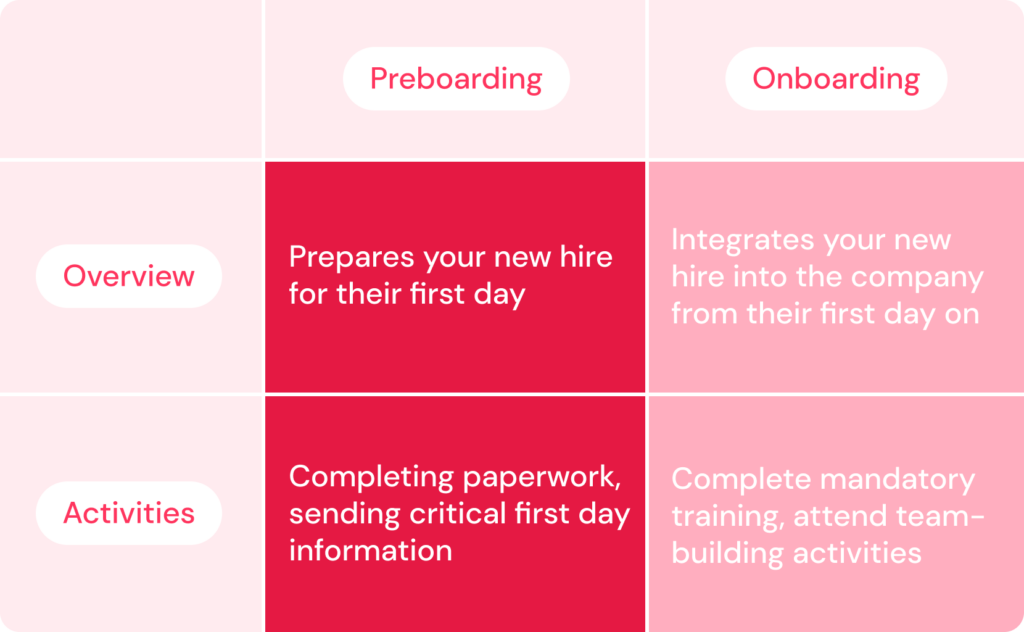
Preboarding refers to the activities that take place after an employee accepts a job offer but before their official start date. Its primary purpose is to prepare the employee and the organization for a successful first day.
During this period, employers can complete administrative tasks, provide important information, and begin building a connection with the new hire.
Common preboarding activities include:
1. Completing paperwork:
Send employment contracts, tax forms, benefits information, and other documents electronically when possible.
2. Providing first-day details:
Share the start time, location, dress expectations, parking information, and what the employee should bring.
3. Setting up technology:
Prepare computers, email accounts, software access, security credentials, and other essential tools.
4. Introducing the team:
A brief welcome email or virtual introduction can help reduce the uncertainty of joining a new workplace.
5. Sharing useful resources:
Provide an employee handbook, company overview, organizational chart, or introductory training materials.
Effective preboarding helps employees arrive prepared rather than spending their first day dealing with basic administrative tasks.
What Is Onboarding?
Onboarding is the broader process of integrating a new employee into the organization. It usually begins on the first day and can continue for several weeks or months. Unlike preboarding, onboarding focuses more heavily on helping employees understand their role, responsibilities, workplace culture, and expectations.
An effective onboarding programme may include:
1. Company orientation:
Introduce the organization, its values, policies, and structure.
2. Role-specific training:
Explain responsibilities, work-flows, tools, and performance expectations.
3. Team integration:
Help new employees establish relationships with managers and colleagues.
4. Goal setting:
Establish clear short-term and long-term objectives.
5. Regular check-ins:
Managers should provide opportunities for questions, feedback, and guidance.
Onboarding should not be treated as a single-day event. Employees often need ongoing support before they feel fully confident in their roles.
Preboarding vs. Onboarding: The Key Difference
The simplest distinction is timing and purpose. Preboarding happens before the employee officially starts and focuses on preparation and reducing uncertainty. Onboarding begins when employment starts and focuses on integration, training, engagement, and productivity.
However, the two processes work best when they are connected. Information collected during preboarding can make onboarding more efficient, while onboarding can build on the positive expectations created before the first day.
Conclusion
Preboarding and onboarding are two connected stages of a successful employee onboarding process. Preboarding prepares employees before they arrive, while onboarding helps them become confident and productive members of the organization.
By investing in both stages, businesses can reduce first-day stress, improve communication, strengthen employee engagement, and create a more positive start for every new hire.




More Stories
Matthew Syken’s Corporate Legal Leadership in a Changing Business Landscape
Digital Quality Assurance Models Powered by Quality Control Inspection and Real-Time Manufacturing Audits
Operational Excellence in Healthcare: Keith Myers’ Strategic Leadership Approach